Ethiopian calendar
How the platform enters, shows and stores dates when the site works in the Ethiopian calendar (EC).
Location: Settings › System, General tab, System input calendar
Available to: Administrator
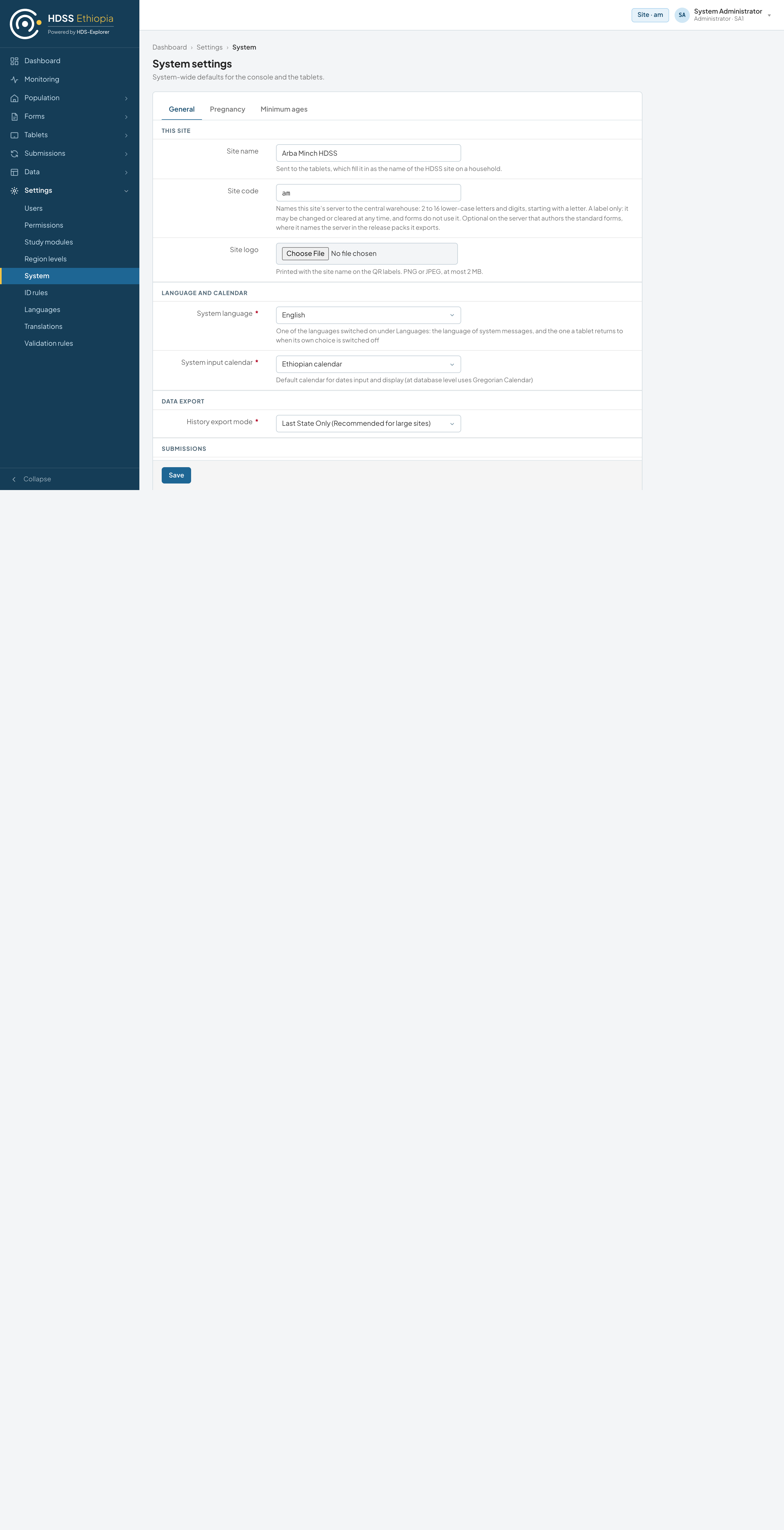
The setting
| Setting | Values | Default | Effect |
|---|---|---|---|
| System input calendar | Gregorian calendar, Ethiopian calendar | Ethiopian calendar | The calendar in which the server console and the tablets show dates and take them as input. |
- Dates are always stored in the Gregorian calendar. The setting changes only how a date is shown and typed. Switching it never changes a stored date, so it can be changed at any time.
- On the console, the change applies as soon as you select Save.
- The tablets receive the change with the settings on their next download.
Where each calendar is used
With Ethiopian calendar selected:
| Where | Calendar | Example |
|---|---|---|
| Console lists and record pages (rounds, members, households, residency events, datasets on screen) | Ethiopian | 2019-03-15 EC; with a time, 2019-03-15 09:30:00 EC |
| Console date boxes (filters, dashboard filters, record edit fields) | Ethiopian, typed as yyyy-mm-dd, with an EC label beside the box and an Ethiopian date picker |
2019-03-15 |
| Search boxes on the submission screens | Ethiopian; a year, a year and month, or a full date, with or without EC |
2019, 2019-03, 2019-03-15 EC |
| Dashboard and monitoring | Ethiopian dates; yearly charts count Ethiopian years, from 1 Meskerem to the last day of Pagume | Round 2 so far (2019) |
| Dates inside console messages, for example a refused round or a rejected submission | Ethiopian | 2019-03-15 EC |
| PDF downloads | Ethiopian, in the rows and in the "Exported by … on …" line | 2019-03-15 09:30 EC |
| Data files (CSV and ZIP downloads of datasets, queries, register datasets and reports) | Gregorian, always | 2026-11-24 |
| Tablet screens outside the forms (lists, badges, household and member details) | Ethiopian, with the month named in the tablet language | 15 Hidar 2019; with a time, 15 Hidar 2019, 09:30 |
| Tablet form questions that ask for a date | Ethiopian, chosen on day, month and year wheels | 2019-03-15 EC |
| Data sent between the server and the tablets | Gregorian, always |
With Gregorian calendar selected, every place in the table shows Gregorian dates, with no EC label and no suffix.
Note
Data files stay Gregorian so that statistical software reads the dates correctly. Convert dates in the analysis if a report needs them in the Ethiopian calendar.
The EC suffix
ECafter a date means the date is in the Ethiopian calendar:2019-03-15 ECis 15 Hidar 2019.- A date without
ECon the console is Gregorian. - In a console date box you do not type
EC: the box takesyyyy-mm-dd, and the EC label beside it shows which calendar the box expects. - Tablet screens outside the forms name the month instead (
15 Hidar 2019) and show no suffix.
How dates convert
| Rule | Detail |
|---|---|
| Months | Twelve months of 30 days, then Pagume, the 13th month, of 5 days (6 in a leap year). In yyyy-mm-dd, the month is a number from 01 (Meskerem) to 13 (Pagume). |
| Month names | 1 Meskerem, 2 Tikimt, 3 Hidar, 4 Tahsas, 5 Tir, 6 Yekatit, 7 Megabit, 8 Miyazya, 9 Ginbot, 10 Sene, 11 Hamle, 12 Nehase, 13 Pagume. |
| Leap years | An Ethiopian year is a leap year when it leaves 3 when divided by 4 (2015, 2019, 2023 EC). Only Pagume changes: it has 6 days. |
| New year | 1 Meskerem falls on 11 September, or on 12 September in the Gregorian year after an Ethiopian leap year. |
| Invalid dates | A date that does not exist, such as Pagume 6 in a common year or month 14, is refused in a date box and ignored in a search. |
| Typed dates | A date typed or picked in the Ethiopian calendar is converted to the Gregorian date of the same day and stored. |
| Times | The time of day is the 24-hour clock of the device or server, in both calendars. The platform does not use the Ethiopian 12-hour time count. |
| Age instead of a date of birth | When a form estimates a date of birth from an age in years, it uses 1 Megabit of the birth year in the Ethiopian calendar, or 1 July in the Gregorian calendar. |
Examples:
| Ethiopian | Gregorian |
|---|---|
| 2019-01-01 EC (1 Meskerem 2019) | 2026-09-11 |
| 2019-03-15 EC (15 Hidar 2019) | 2026-11-24 |
| 2019-13-06 EC (6 Pagume 2019, leap year) | 2027-09-11 |